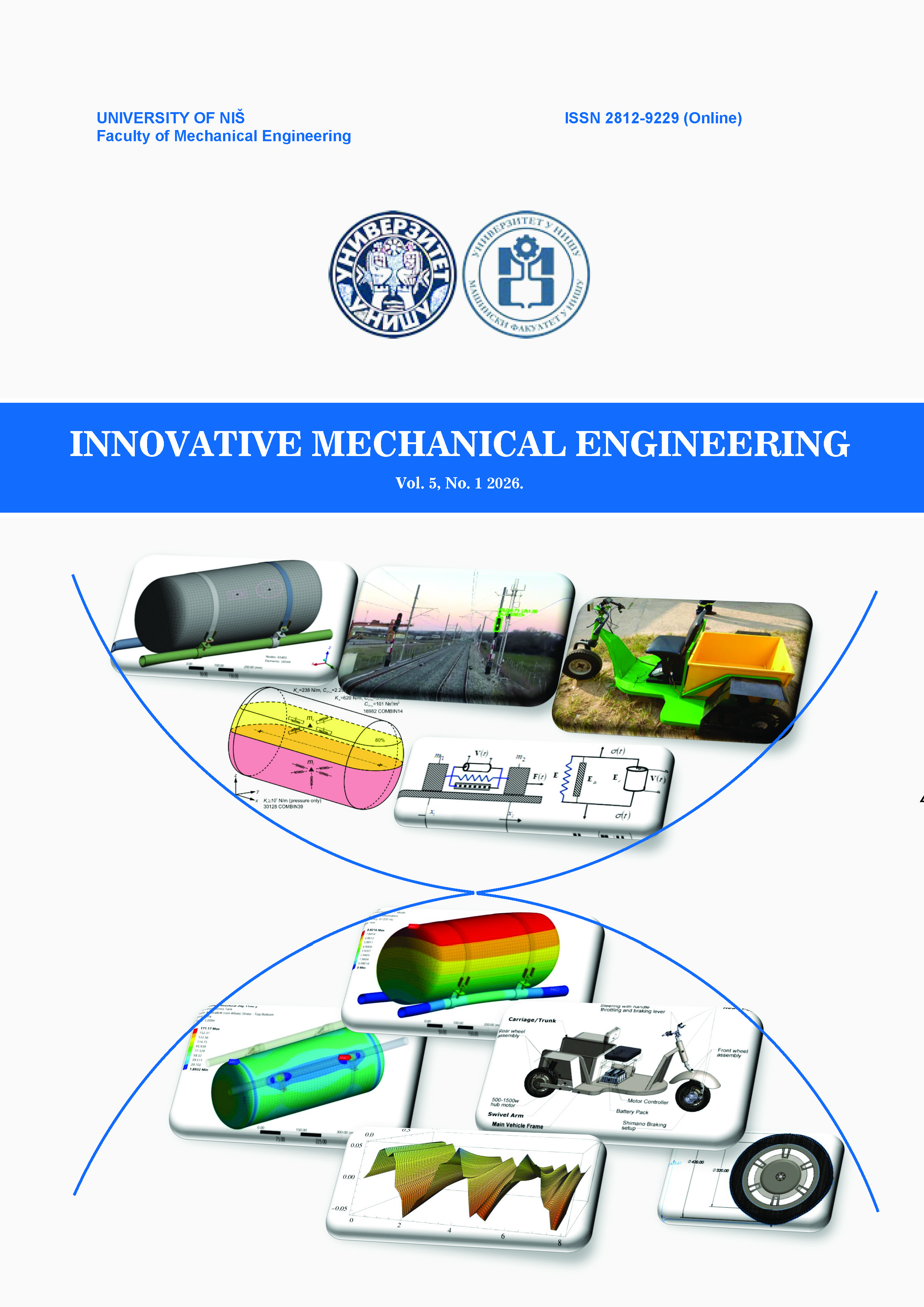
NUMERICAL ASSESSMENT OF STRUCTURAL INTEGRITY AND FATIGUE LIFE OF AUTOMOTIVE LPG TANK AND MOUNTING COMPONENTS UNDER REGULATORY LOADING CONDITIONS
Keywords:
LPG tank structure, Finite Element Analysis, Structural integrity, Fatigue life prediction, Random vibration, Power Spectral DensityAbstract
A nonlinear finite element model was formulated to assess the structural integrity and fatigue life of an automotive LPG tank assembly comprising the cylindrical pressure vessel, clamping straps, holders, and telescopic supports. Experimentally characterized material properties and realistic frictional contacts were incorporated, while fluid–structure effects were approximated via mass–spring surrogates for sloshing and internal pressure. The assessment covered static and quasi‑static scenarios (bolt pretensioning, tank filling) and dynamic conditions consistent with regulatory impacts of 8g lateral and 20g longitudinal accelerations. Vibrodynamic fatigue evaluation employed a Power Spectral Density methodology based on Welch’s estimator to predict life under stochastic vehicle‑induced excitation. Results indicate no catastrophic failure across loading regimes; however, mounting straps exhibit pronounced plasticity during tightening and accumulate ~91% fatigue damage at ten years, aligning with mandated replacement intervals. The pressure vessel shows negligible fatigue degradation and an unrealistically extended predicted life, motivating future work that incorporates cyclic filling/emptying through transient drive–idle–refuel sequences and derived load spectra. The methodology provides a rigorous computational basis for durability assessment and compliance verification of LPG tank installations while reducing reliance on extensive physical testing.