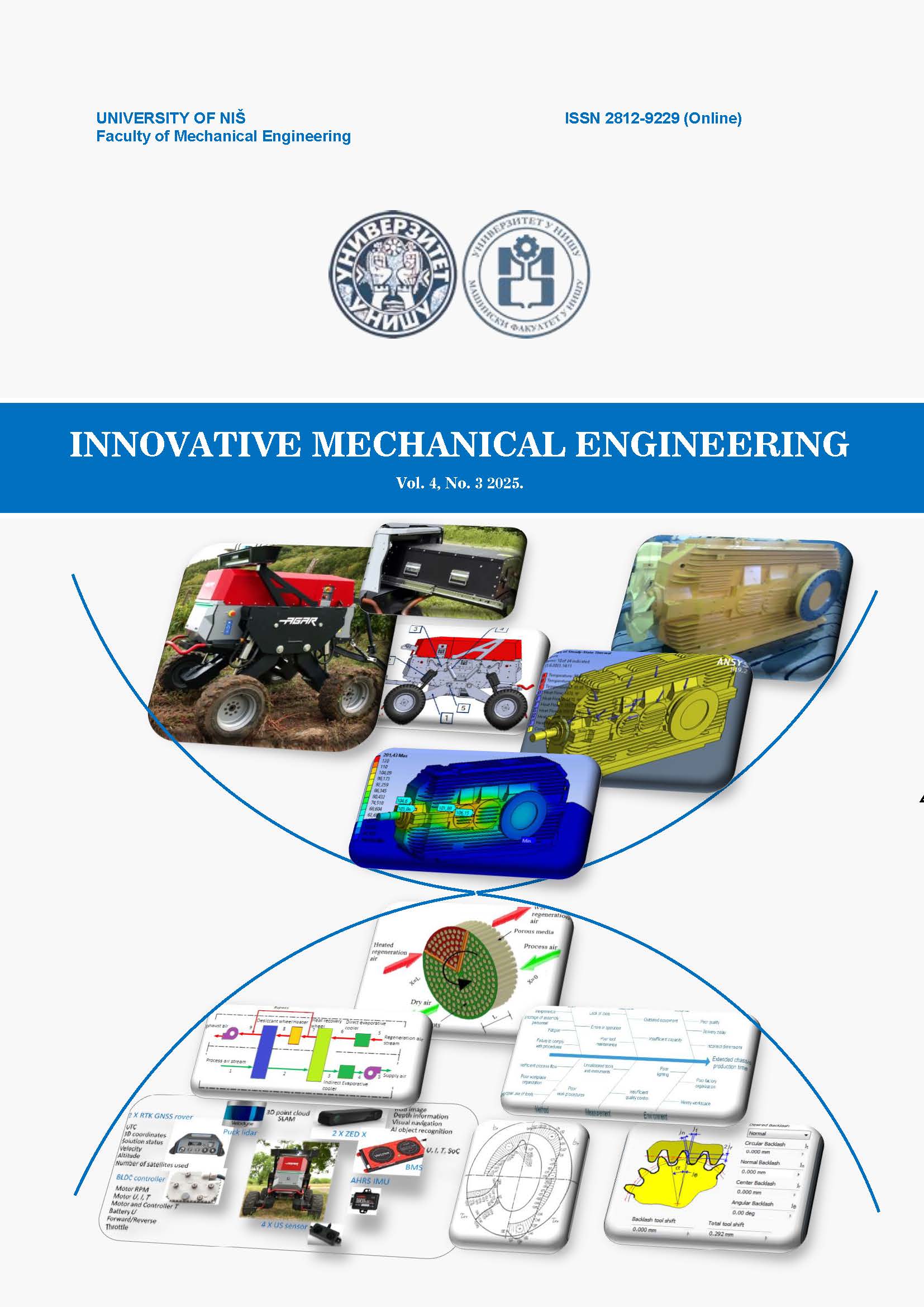
AGAR: DESIGN AND CONTROL SYNTHESIS FOR A NEXT-GENERATION AGRICULTURAL GROUND ROBOT
Keywords:
Unmanned Ground Vehicle (UGV), Agriculture robot, Mechanical design, Control design, Hybrid suspension, Design advantagesAbstract
Unmanned ground vehicles (UGVs) emerge as practical enablers of automation for labor-intensive agricultural operations, but real deployment is still constrained by a persistent design tension: machines that are versatile enough to justify investment often become too heavy/rigid for uneven terrain, while lightweight robots typically sacrifice implement compatibility and slope stability. This paper first synthesizes recent advances in agricultural UGV mechanical architectures and autonomy stacks, with emphasis on drivetrain choices, suspension/levelling concepts, energy supply, perception, and hierarchical control. It then presents AgAR (Agriculture Autonomous Robot) as an integrated design-and-control solution that deliberately couples mechanical modularity with a layered autonomy framework. AgAR combines a lightweight modular chassis with four independently actuated wheel-leg modules forming a hybrid suspension/active levelling system, enabling dynamic ground-clearance control and improved stability on rough and sloped fields. A swappable battery concept supports long duty cycles, while optional modules-including a Category-I three-point hitch and an electric PTO-enable direct use of standard tractor implements and higher-power attachments. A multimodal sensor suite (RTK-GNSS, IMU, stereo vision, 3D LiDAR, ultrasonics) feeds a ROS-centered architecture that separates localization, perception, planning, and safety, supported by industrial control hardware for deterministic low-level actuation and fail-safe stops. Comparative analysis against representative contemporary platforms highlights AgAR’s distinctive combination of terrain adaptability, interoperability with conventional implements, and extensible autonomy.